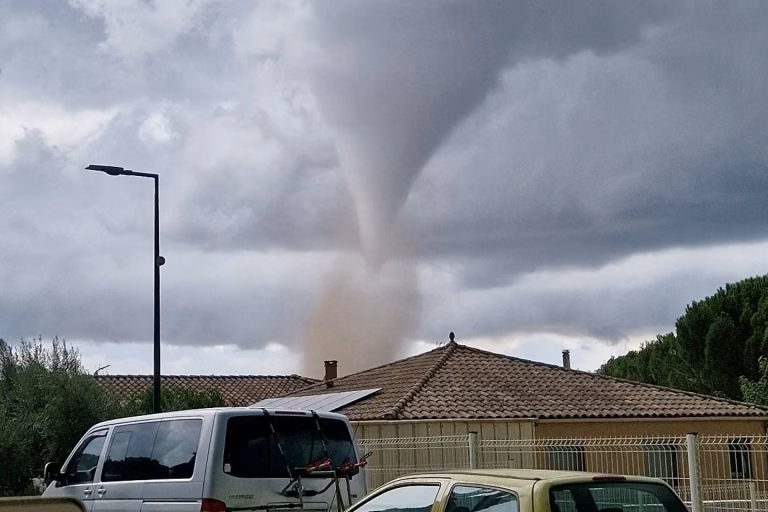
Tornadoes are among the most destructive weather phenomena in the United States, particularly across the Great Plains where powerful storms frequently generate violent twisters. However, not all regions face the same level of risk. Some parts of the country experience very few tornadoes, making them significantly safer when it comes to this specific natural hazard.
Based on long-term data from the National Weather Service and historical records, several U.S. states stand out for their remarkably low tornado frequency. These locations either lack the necessary atmospheric ingredients or have geographic features that limit tornado formation.
Alaska – The Rarest Tornado State in America
When it comes to tornado activity, Alaska is by far the quietest region in the United States. Despite being the largest state in the country, it has recorded only four tornadoes since 1950.
The main reason lies in the atmospheric conditions. Tornadoes typically require a combination of warm, moist air colliding with cooler air masses. While Alaska does experience storms and humidity during short summer periods, it lacks the sustained warm air needed to fuel tornado formation.
Even though Alaska is known for extreme weather, including powerful winter storms and rugged wilderness conditions, tornadoes are virtually nonexistent.
Hawaii – Rare Tornadoes in a Tropical Paradise
Hawaii offers a completely different climate, yet tornadoes remain uncommon. Since 1950, only 42 tornadoes have been recorded across the islands.
The state has abundant warm air and humidity, but it lacks strong cold air systems that are essential for severe storm development. Additionally, the mountainous terrain of the islands makes it difficult for tornadoes to form and sustain themselves.
Although a few tornadoes have caused damage in the past, fatalities are extremely rare, and entire decades have passed without a single recorded event. Compared to mainland tornado hotspots, Hawaii remains a low-risk region.
Maine – Low Tornado Risk in New England
In the northeastern United States, Maine is one of the safest areas when it comes to tornadoes. The state averages only about two tornadoes per year, according to local emergency management data.
New England’s climate and terrain play a significant role in limiting tornado activity. The region is dominated by forests, hills, and mountains, which are not favorable for the development of large, long-track tornadoes.
While Maine does experience other forms of severe weather, such as winter storms, coastal flooding, and occasional hurricanes, tornadoes remain a rare occurrence and rarely cause significant damage.
District of Columbia – Minimal Tornado History
Although not officially a state, District of Columbia is often included in analyses due to its extremely low tornado activity. Since 1970, only three significant tornadoes have been recorded, with two occurring on the same day in 2001.
Despite having some of the atmospheric ingredients needed for storms, the region has largely avoided major tornado impacts. This is notable given its proximity to states like Maryland and Virginia, which experience far more frequent severe weather.
Overall, tornado risk in Washington, D.C. remains very low compared to other parts of the country.
Nevada – Dry Conditions Limit Tornado Formation
Nevada rounds out the list as one of the least tornado-prone states. Since 1950, fewer than 100 tornadoes have been recorded across the entire state.
Nevada’s arid climate is the key factor. Tornadoes require moisture, and the desert environment simply does not provide enough of it. While temperatures can vary significantly between day and night, the lack of humidity prevents the development of strong storm systems.
Compared to states like Kansas or Texas, where thousands of tornadoes have occurred, Nevada’s numbers are extremely low, and the overall damage from tornadoes has been minimal.
Why Some States Avoid Tornadoes
Tornado formation depends on a specific combination of atmospheric conditions, including warm moist air, cold dry air, wind shear, and unstable weather patterns. When one or more of these elements are missing, tornadoes become far less likely.
In the case of these five regions, factors such as cold climates, dry air, mountainous terrain, or geographic isolation disrupt the formation process. As a result, these states experience significantly fewer tornadoes than the central United States.
A Stark Contrast to Tornado Alley
While these states remain relatively safe, other regions — particularly the central U.S. — face a much higher risk. Areas like Texas, Oklahoma, and Kansas experience hundreds of tornadoes annually due to ideal atmospheric conditions.
This contrast highlights how geography and climate play a critical role in determining severe weather patterns across the country.