
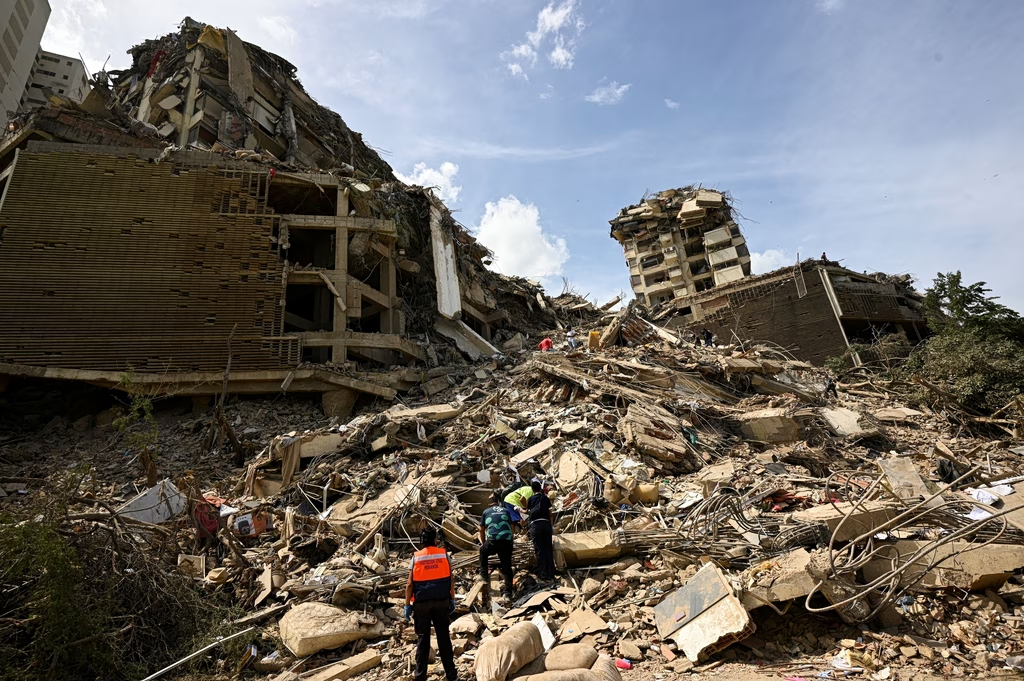
Venezuela is facing one of the deadliest natural disasters in its recent history after two powerful earthquakes struck the country’s northern coast, killing at least 188 people, injuring more than 1,500, and leaving hundreds trapped beneath collapsed buildings.
Rescue operations continue around the clock as emergency crews race against time to locate survivors in devastated communities, while officials warn that the death toll could continue to rise in the coming days.
The disaster has prompted an international humanitarian response, with specialized search-and-rescue teams already deploying to assist Venezuelan authorities.
Twin Powerful Earthquakes Strike Northern Venezuela
The earthquakes struck Wednesday evening near Venezuela’s northern Caribbean coastline, east of the capital, Caracas.
According to the U.S. Geological Survey (USGS), the first earthquake measured magnitude 7.2 before being followed just 39 seconds later by an even stronger magnitude 7.5 earthquake.
The back-to-back shocks caused widespread structural damage across several communities, catching many residents inside their homes during a national holiday.
Hundreds of Buildings Collapse
Authorities report that approximately 250 buildings have either collapsed completely or suffered catastrophic structural damage.
Emergency officials estimate that more than 200 people remain trapped beneath the rubble, with rescue crews working continuously despite the danger posed by ongoing aftershocks.
Search operations are focusing on residential buildings that collapsed during the strongest shaking.
Death Toll Continues to Rise
Venezuelan authorities confirmed that at least:
- 188 people have been killed
- 1,520 people have been injured
- 157 people remain missing
Officials warn that these figures remain preliminary as rescue teams continue searching damaged neighborhoods.
Many hospitals are treating large numbers of injured residents while emergency shelters accommodate thousands of displaced families.

Coastal Region Suffers Worst Damage
The hardest-hit area is La Guaira State, located along Venezuela’s northern coastline near Caracas.
Images from the disaster zone show apartment buildings partially collapsed, heavily damaged residential complexes, and streets filled with debris.
Entire neighborhoods have suffered severe destruction as rescue workers search through unstable structures for survivors.
Aftershocks Continue to Threaten Rescue Efforts
The USGS warns that significant aftershocks remain possible following the twin earthquakes.
Seismologists note that rescue operations are especially dangerous because damaged buildings could collapse further if additional strong aftershocks occur.
According to the USGS rapid impact assessment, there remains a significant probability that the final death toll could increase substantially as rescue operations continue.
International Rescue Teams Deploy
The United States has announced humanitarian assistance to support rescue operations in Venezuela.
Two highly trained Urban Search and Rescue (USAR) teams are being deployed to assist local emergency responders.
The Fairfax County Urban Search and Rescue Team from Virginia is sending approximately:
- 80 rescue specialists
- Six search dogs
- Structural engineers
- Emergency physicians
- More than 70,000 pounds of specialized rescue equipment
The teams will use advanced listening devices, search cameras, and heavy rescue tools capable of locating and extracting victims trapped beneath collapsed concrete structures.
Additional rescue specialists from Los Angeles County are also expected to assist operations.
Healthcare System Under Pressure
Medical experts warn that Venezuela’s healthcare system is facing enormous pressure as hospitals struggle to treat the growing number of injured patients.
Years of limited investment in healthcare infrastructure have left many hospitals operating with reduced capacity, making emergency response even more challenging following a disaster of this magnitude.
Authorities are coordinating both public and private medical resources to provide treatment for those injured during the earthquakes.
Rescue Efforts Continue
Emergency officials say the coming days will be critical as rescue teams continue searching collapsed buildings for survivors.
Heavy equipment, search dogs, thermal imaging cameras, and specialized listening devices are being deployed throughout the disaster zone.
Authorities continue urging residents to remain cautious due to the ongoing risk of aftershocks while humanitarian aid begins arriving from international partners.
The twin earthquakes represent one of the most destructive seismic disasters to strike Venezuela in decades, leaving thousands of families displaced as recovery and rescue operations continue.


