
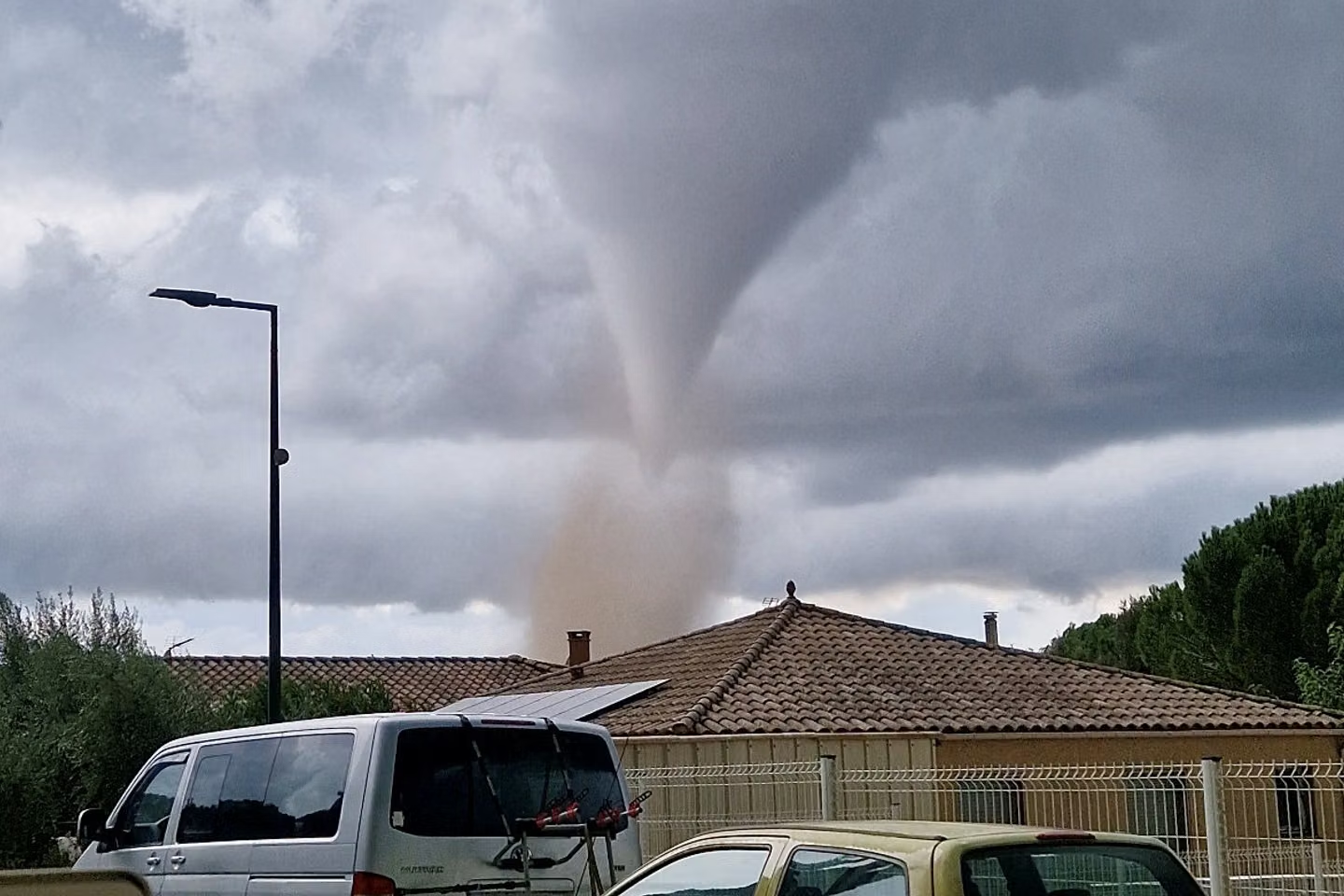
A powerful tornado spawned by a violent supercell thunderstorm swept through parts of southern France, leaving a trail of destruction across the Aude department, near Carcassonne.
At least 26 people were reported injured, homes were damaged or partially destroyed, trees were uprooted and thousands of households lost electricity as the severe storm moved through the region.
Videos recorded by residents captured the dramatic moment the tornado developed beneath the supercell and moved across populated areas.
Tornado strikes southern France
The tornado was observed near Carcassonne, with some of the most dramatic footage coming from the village of Verzeille, where a rotating funnel could be seen extending from the base of the thunderstorm.
The storm produced extremely strong winds as it crossed the area, damaging buildings, vegetation and local infrastructure.
According to initial reports, approximately 2,800 households lost electricity following damage caused by the storm.
The small community of Pomas, home to around 1,000 residents, was among the hardest-hit locations.
Several houses suffered significant roof damage, while some structures were reportedly severely damaged.
Watch the dramatic videos from southern France below:
26 people reported injured
Emergency services were deployed across the affected communities following the tornado and the accompanying severe thunderstorms.
At least 26 people were reported injured as authorities began assessing the full extent of the damage.
Images and videos shared from the area showed roofs ripped from buildings, fallen trees and debris scattered across streets.
The event occurred during a broader outbreak of severe thunderstorms affecting southern France.
Aude was under an orange weather alert
Forecasters had warned ahead of the storms that atmospheric conditions could support dangerous thunderstorms capable of producing torrential rainfall, large hail and violent wind gusts.
Aude was among 22 French departments placed under an orange weather alert as the severe weather threat increased.
The first reports of the tornado emerged at around 5:20 p.m. local time.
The storm responsible for the tornado developed into a supercell, a particularly organised type of thunderstorm characterised by a persistent rotating updraft.
Supercells can produce some of the most dangerous convective weather, including very large hail, destructive straight-line winds, intense rainfall and tornadoes.
Why did such a powerful storm develop?
Atmospheric conditions across southern France were particularly favourable for the development of severe thunderstorms.
A low-pressure system approaching from the Atlantic interacted with very warm and moisture-rich air moving northward from the Mediterranean.
Temperatures in the affected region were close to 27°C, providing substantial low-level warmth and moisture.
At the same time, changes in wind speed and direction with altitude created significant wind shear.
The combination of atmospheric instability and strong wind shear can allow a thunderstorm’s updraft to begin rotating. When this rotation becomes sufficiently organised and persistent, the storm can evolve into a supercell.
Under certain conditions, that rotation can eventually extend toward the surface and produce a tornado.
Severe thunderstorm threat across southern France
The tornado was part of a much broader episode of severe weather.
Forecasters warned that thunderstorms across southern France could produce large hail, torrential rainfall, destructive wind gusts and isolated tornadoes.
The French severe-weather observatory Keraunos had also highlighted the potential for significant severe thunderstorms.
Events such as this demonstrate why a thunderstorm does not necessarily need to cover a huge geographical area to become extremely destructive. A well-organised supercell can concentrate violent winds, hail and intense precipitation across a relatively narrow corridor.
Tornadoes are not unknown in France
Although tornadoes are considerably less frequent in France than in the central United States, they are not an unknown phenomenon in the country.
France has experienced several violent tornadoes throughout its recorded history.
According to historical data cited by Keraunos, 17 tornadoes have reached EF4 or EF5 intensity in France, including two events classified at the highest EF5 level, in 1845 and 1967.
One of the best-known modern French tornadoes occurred on 3 August 2008, when a violent tornado struck the Hautmont area in northern France.
That tornado travelled for approximately 20 kilometres through the Val de Sambre region, killing three people and seriously injuring 18 others.
The Aude department itself also has a history of violent tornado activity. An EF4 tornado struck La Redorte on 12 August 1887.
The final intensity of the latest tornado, however, should not be assumed from the videos alone. A reliable rating requires a detailed post-storm damage survey.
Damage assessments continue
Authorities and emergency crews are continuing to assess the damage left behind by the tornado and the wider severe thunderstorm episode.
The combination of a rotating supercell, strong atmospheric instability and significant wind shear created the conditions for a particularly dangerous storm across southern France.
For residents, the event unfolded extremely quickly, once again highlighting how rapidly severe convective storms can develop and become hazardous.
As damage surveys continue, meteorologists will be able to establish more precisely the tornado’s path, maximum width and intensity.


