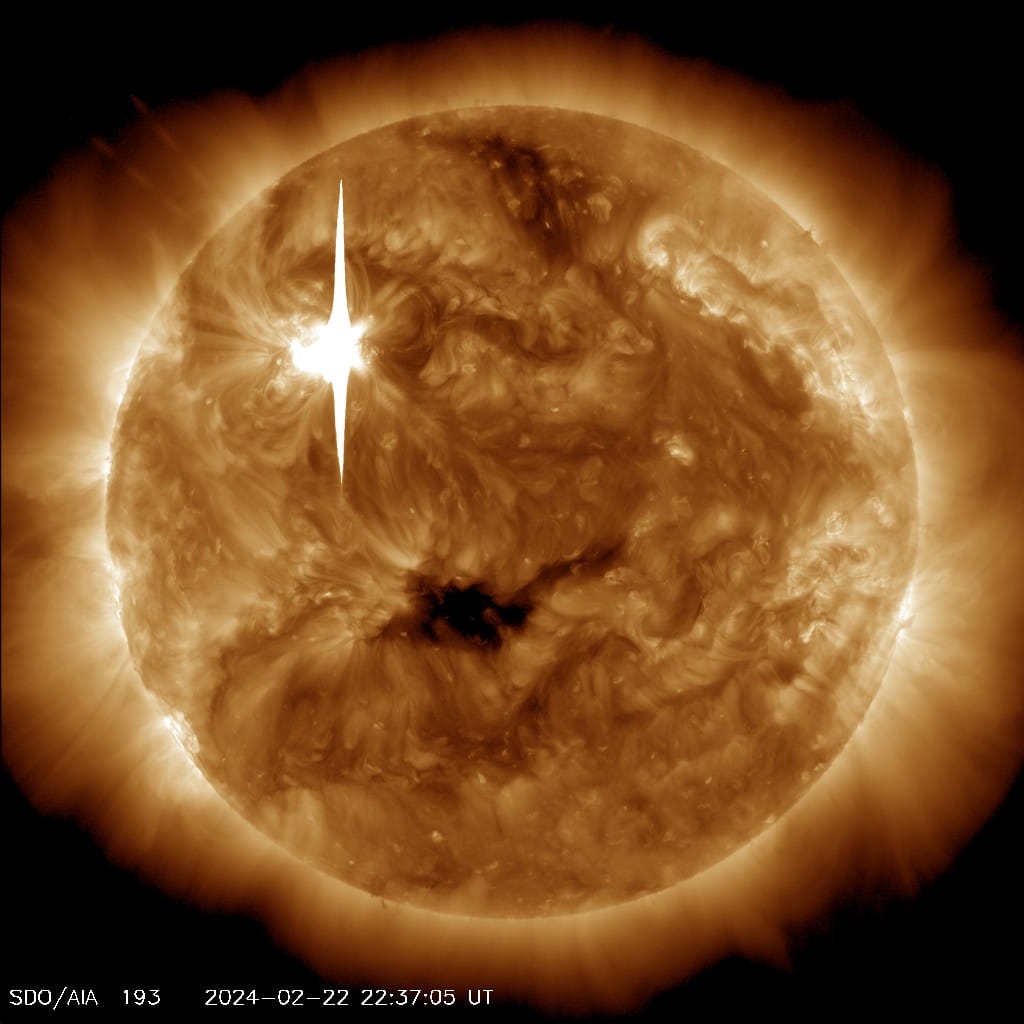
The Sun emitted a strong solar flare, peaking at 5:34 p.m. EST on Feb. 22, 2024. NASA’s Solar Dynamics Observatory, which watches the Sun constantly, captured an image of the event.

Solar flares are powerful bursts of radiation that occur on the Sun’s surface. They are the solar system’s largest explosive events and are caused by the release of magnetic energy stored in the Sun’s atmosphere. This release happens when the magnetic field lines near sunspots become twisted and realigned, resulting in a sudden and intense variation in brightness. Solar flares emit energy across the entire electromagnetic spectrum, from radio waves to gamma rays.
The energy released by a solar flare can be immense, equivalent to millions of 100-megaton hydrogen bombs exploding at the same time. Solar flares can impact Earth in several ways, particularly by affecting satellite operations, radio communications, and power grids. They are also responsible for the beautiful auroras (Northern and Southern Lights) observed near the polar regions of the Earth.
Solar flares are classified into three categories based on their X-ray brightness in the wavelength range 1 to 8 Angstroms. The classifications are:
X-Class Flares: These are the most intense flares. They can cause planet-wide radio blackouts and long-lasting radiation storms.
M-Class Flares: These are medium-sized; they can cause brief radio blackouts that affect Earth’s polar regions. Minor radiation storms might follow.
C-Class Flares: These are small with few noticeable consequences on Earth.
The study of solar flares is important not only for understanding the Sun’s processes but also for preparing and protecting our technology and communication infrastructure against solar weather effects.