


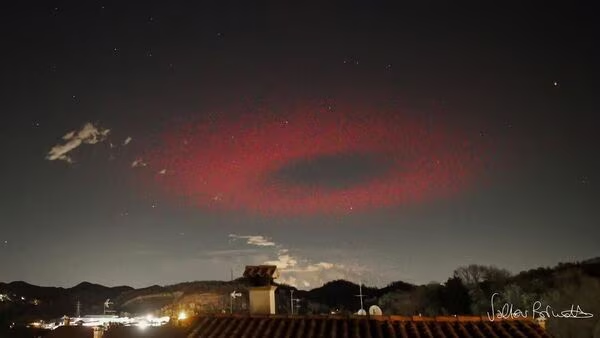
Residents of the small town of Possagno in northern Italy were stunned on November 17 when a glowing red halo-like ring appeared in the night sky. Remarkably, this wasn’t the first time the community had witnessed the mysterious display. A similar red ring had illuminated the sky in March 2023, and on both occasions, the rare phenomenon was captured by photographer Valter Binotto.
The most recent event occurred around 10:45 PM local time. Although fainter than the 2023 occurrence, the red ring was still visible to the naked eye, prompting curiosity and awe among locals.
What were these red rings?
Despite their eerie appearance, scientists have provided a clear natural explanation. According to Live Science, citing spaceweather.com, these luminous rings are known as ELVEs, short for “Emission of Light and Very Low-Frequency perturbations due to Electromagnetic pulse Sources.” They are extremely rare upper-atmospheric optical phenomena.
ELVEs are triggered by exceptionally powerful lightning strikes. When a lightning bolt releases an intense electromagnetic pulse toward space, it interacts with the ionosphere, an electrically charged layer of the atmosphere. The pulse energizes nitrogen molecules, which then emit a vivid red flash. ELVEs typically last only one-thousandth of a second—far too brief for most people to see.
In this case, the lightning strike that generated the ELVE measured an extraordinary 303 kilo-amperes, making it 10 to 30 times stronger than a typical thunderstorm discharge.
Scientists are baffled as a mysterious halo of red light appears over a small Italian town for the second time in 3 years
“An incredible image captures the bizarre UFO–like ring floating above Possagno, a tiny town in the foothills of the Italian Alps.
The photograph was taken… pic.twitter.com/2Qp4kR6Jaa
— ZTF Guide (@ZTFGuide) November 28, 2025
How was this ELVE captured?
Binotto, known for photographing atmospheric phenomena, was actually searching for sprites—another rare form of electrical discharge above storms—when he inadvertently recorded the ELVE instead.
“I didn’t capture any sprites, but fortunately, I managed to capture this ELVE!” he told spaceweather.com.
He used a Sony A7S camera with a 20mm f/1.8 lens at ISO 51,200, shooting video at 25 frames per second, which allowed him to freeze the fleeting flash.
Why Possagno?
Scientists emphasize that the repeated sightings have nothing to do with the town’s geographical location. Instead, they credit the skill, preparation, and persistence of the photographer. Binotto’s work has effectively put the small alpine foothill town on the global map for capturing rare atmospheric events.


